
Cozy coloring technique
How to Color Cozy Night Scenes: Windows, Shadows & Warm Glow
A believable night page needs two color families: a cool environment and a small warm light source. The glow works because of the contrast between them, not because the yellow is especially bright.

01
Plan the light before filling the page
Circle the main light source mentally: a lamp, window, fireplace, moon or string of bulbs. Then decide which nearby surfaces face that source. Those surfaces receive the warmest and lightest colors; surfaces facing away move toward the cool shadow family.
Leave a narrow pale area directly beside the light. If every nearby object is filled with the same strong yellow, the effect becomes a flat yellow patch instead of a glow.
02
Eight steps for a warm window in a cool night
Pick a colored night
Use navy, blue-gray, deep teal or muted violet instead of black. A colored dark leaves room for deeper shadows.
Keep the light center pale
Begin with cream or very pale yellow in the brightest part of the window or lamp.
Build a warm edge
Place honey, peach or soft orange around the pale center, not over all of it.
Echo light nearby
Add a lighter warm version to the nearest tabletop, path, face or curtain edge.
Cool the far side
Move objects away from the light toward blue, violet or cool gray shadows.
Deepen overlaps
Use the darkest night color beneath roofs, awnings, furniture and characters rather than everywhere.
Soften with pencil
After marker is dry, use pencil to bridge abrupt edges or add a narrow halo without soaking the paper again.
Finish with tiny highlights
A white gel pen works best on a few glass edges, stars or reflective points—not as an outline around every object.
03
Three common reasons the glow disappears
First, the surrounding area may be too light. Darken a small zone immediately outside the glow rather than recoloring the whole page. Second, the light may contain no pale center; restore a small highlight with pencil or gel pen. Third, too many unrelated warm colors may be competing. Repeat the same two warm shades wherever that light lands.
If the page already feels busy, stop adding effects. One lamp that clearly affects three nearby surfaces is more convincing than ten separate halos.
Palette cards
Colors to try on the page
Rainy Café
teal night with peach light
Place teal outdoors and let peach and cream appear only behind glass and on the nearest table.
Moonlit Bookshop
blue-violet with golden paper
Use paper and lamp inside; allow moon and dusk to touch exterior roofs, signs and pavement.
Berry Evening
soft and dreamy rather than realistic
A gentle choice for bedrooms, date scenes and small magical shops.
Forest Lantern
dark green woods with amber light
Keep the path and trees green; let amber touch only the lantern, character and nearest plants.
Color the full collection
Books that fit this journal
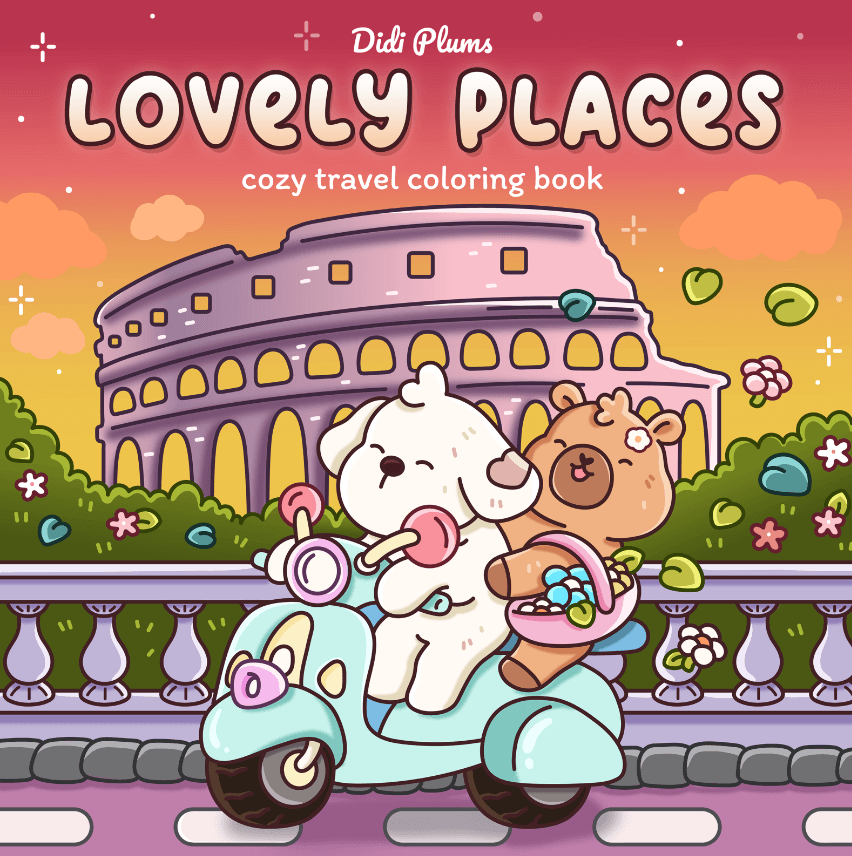
The ideas above work independently. If you want complete scenes ready to color, these digital editions are the closest match.

Questions from the coloring table
Do I need a black marker for night scenes?
No. Navy, deep teal, plum or forest green often creates a softer night and gives you room to use an even darker pencil for the deepest overlaps.
How do I make a window look like it is glowing?
Keep the center pale, surround it with one warmer middle color, then make the immediate exterior cooler and darker. Add a small trace of the warm color to a nearby surface.
Can I add glow after the page is already colored?
Yes. Deepen the area just outside the light with pencil, restore a small pale center with an opaque pencil or gel pen, and add a narrow warm reflection to the nearest object.
Keep exploring